
 Apple Podcasts
 Spotify
 Castro
 RSS Feed
 Amazon Music
 Audacy
 iHeartRadio
 Podcast Addict
 Deezer
 Writing and Publishing with Andrew Najberg
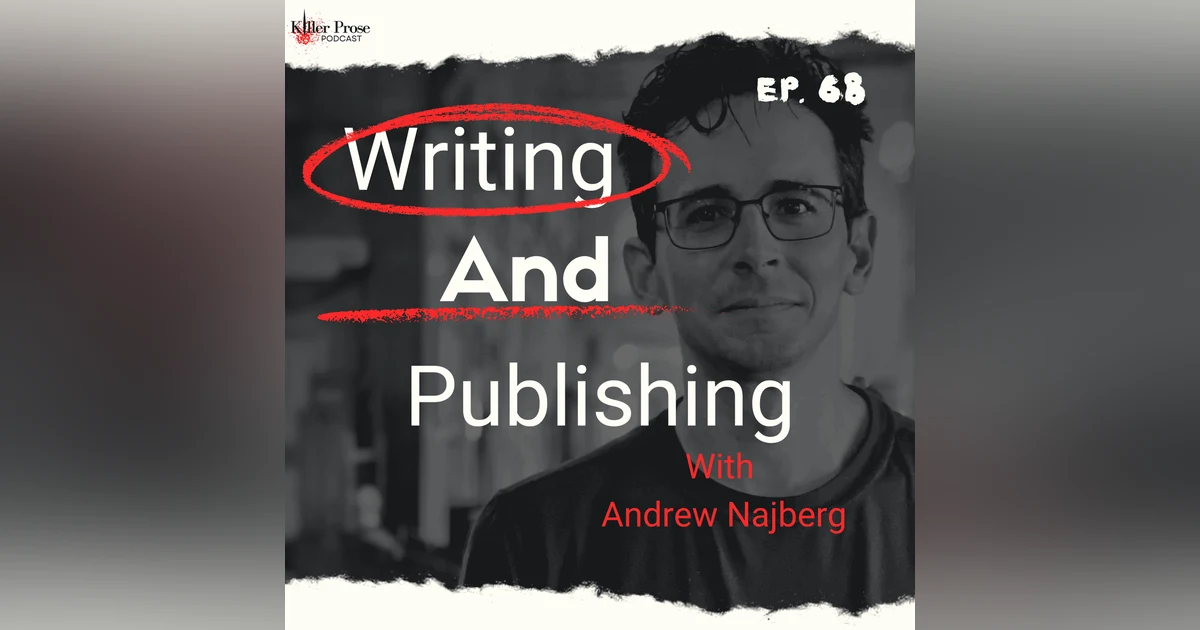
In this episode I talk to author Andrew Najberg about balancing the art of writing with the business of publishing. I ask what's changed in his process since stepping into his new Role at Wicked House Publishing. We also talk about his new book Eat the Light.
Connect with Andrew at:
Meet Andrew at:
Connect with the show at:
- Join the Discord Community for live Writing Sprints: https://discord.gg/xkm9TPMzzb
- Killer Prose Podcast: https://www.killerprose.com/
- Tanner Rutledge: https://tannerrutledgebooks.com/
- YouTube: https://www.youtube.com/@KillerProse6645
- Instagram: https://www.instagram.com/killerprosepodcast/?hl=en
- Narration IG: https://www.instagram.com/tannerrutledgevo/?hl=en
- email me: killerpenbooks@gmail.com
Intro Music: Super Strange Synths by YellowTree -- https://freesound.org/s/482961/ -- License: Attribution 4.0
00:00 - Untitled
00:28 - Introduction to Eat the Light
01:13 - Exploring the World of 'Eat the Light'
12:05 - The Dynamics of Character Development
20:02 - The Revision Process in Storytelling
25:15 - Transitions in Publishing: Balancing Art and Commerce
30:42 - Exploring the LITRPG Genre
34:21 - Exploring the Depths of Horror Literature
43:35 - Navigating the Balance Between Artistic Vision and Market Viability
46:31 - Navigating the Writing Journey: Advice for Aspiring Authors
Opening Music
TannerWelcome back to the Killer Pros podcast. I'm your host, Tanner, and I'm joined today by Andrew Nyberg from Wicked House Publishing and the author of his new release, Eat the Light.Andrew, how you doing?
Andrew NajbergDoing fantastic, man. Thanks so much for having me. It's always exciting to catch up.
TannerIt's been a minute since I had you on. I think you and Brad are the ones that have been on the show the most since I started.
Andrew NajbergOh, Brad is just a fabulous guest on anything. He's always just so much fun to talk to.And if you haven't heard him sing karaoke, the next time you get him on your podcast, you've got to convince him to sing something because he's pretty fantastic.
TannerOoh, I have a music setting on this. I might do that.
Andrew NajbergNice.
TannerSo your new release is Eat the Light. Why don't you tell us a little bit about it?
Andrew NajbergWell, Eat the Light, in sort of a nutshell, it's dystopian post apocalyptic horror, and premise is pretty simple. Two young sisters, Alyssa and Tabitha, Alyssa being the older, are home playing one day, and their father arrives home brandishing a shotgun.And he pretty quickly has a brief argument with his wife, slash their mother. And then the two parents shuffle the kids downstairs into the basement and reveal a hidden bunker that the children were completely unaware of.And the parents shepherd the kids down inside and then seal them in and leaving these kids to navigate their new reality. And that's sort of the main premise.And the storytelling itself is divided between two timelines, one of which charts the girls as they navigate their initial arrival into the bunker, as I generally call it.And then the other timeline takes place at an indeterminate point point where you see the sisters have emerged from the bunker and are attempting to navigate what has become an incredibly hostile landscape. It is populated by some more traditional threats, such as wild dogs and other similar creatures that have gone feral.But also the world itself seems to be in some sort of process of corruption. There's strange growths starting to encompass everything. The rain has become caustically acidic.And there are these strange beings called the girls, called the Shimmer People, who are wandering through the town for unknown motivations. But they are beings that seem to be essentially made of light.
TannerInteresting. I've been reading from my other show, truly odd of these kind of gas like light anomalies that seem to have some sort of consciousness.Were you looking into that and did that play into the Shimmer people or.
Andrew NajbergSo one of my favorite types of myth or folklore or folk Creature has always been the will of the wisp. You know, the nebulous kind of glowing ball creatures. They've shown up in a couple of my pieces in various capacities.And that was sort of the starting point of this one.One of the tropes I wanted to sort of play with, because I always do have some sort of some core concepts that I sort of want to invert or subvert during the course of my novels. And, you know, oftentimes in sort of survival and horror stories, you know, the light is always the signifier of safety.Going into the darkness is typically the signifier of death and danger. And so I really wanted to make the light much more menacing in this one. And, of course, you know, the title itself is Eat the Light.And that's also playing off of that idea as well. You know, there's sort of the idea that, you know, the hope that things are going to get better when light reveals things.You know, it's a hollow hope. It's not going to feed you. You can't eat it. And so at that point, you know, light is also something potentially devouring.And so, yeah, there's a couple of different things I was playing with in that. But, yeah, it really did start with the idea of sort of picturing these more. More formidable will of the wisps.These aren't just glowing balls of light trying to lead you astray.
TannerThat's fun. Subverting tropes. There's always a mixture of tropes and different stories.I'm going through Autocrit and kind of testing out some of new features right now. And one of them is a journey Builder.And in the planning stage of the Journey Builder, if you're going through, like, Plantser, where you're just kind of outlining briefly and jumping in and doing a lot of discovery writing, there's one spot where it says, pick your tropes and pick at least three tropes for your story.There's the main trope that you're playing in the trope that you're going to subvert and twist, and then the comfort trope that the reader is comfortable with. And they're like, oh, I know exactly what type of story this is that keeps them in there.Do you do that with your writing when you're picking out the tropes, or do they just reveal themselves as you're going through the process?
Andrew NajbergI'm definitely largely a discovery writer. I do tend to have some things planned in advance.Like, one of the best examples is in Mobius Store And I think that book's been around long enough that I can easily spoil without giving things away or without causing problems for readers. But really late in the novel, the main characters, they're sort of entering into this immersive darkness that's consuming their town.And at one point, Heather, one of the primary protagonists, finds herself in this sort of almost magical sheltered grove inhabited by this being named Perun.And in Croatian folklore, Peron and Perun and Veles are sort of complementary siblings deities, very much like Thor and Loki, actually, those other sort of good brother trickster brother Dyads. And Valaise is one of the two main villains of the novel.And basically the idea is that there's a certain line at which you cross where one of the only routes of hope becomes this idea of divine intervention, right? If you're fighting against a God, how do you defeat a God? And, you know, but then also, you know, as an author, you can't.You can't have a God step in and solve the problem. You know, they literally have that very negative connotation term deus ex machina for that kind of device.And, you know, so I literally wanted to sort of play with that, sort of toy with the idea that that could be there. But then also the deity involved basically says, I don't want anything to do with your problems. Just go away.You know, and, you know, he's completely disinterested. Um, and so, yeah, you know, it was. And that was one of those things that I decided really early on I wanted to play with that just a little bit.You know, it was sort of thinking back to my MFA classes and stuff like that, you know, teacherly advice I'd gotten and all of the repetition. I've never used ASX mocking, and I've written that myself on so many students stories.And I was like, okay, I've got to have a story where the God in the machine shows up. But also, at the same time, I didn't want to make that the solution.So I was kind of again, toying with the trope, very intentionally Extinction Dream had a good bit of that as well, where I subvert sort of the notion of the way flashbacks work. One of the midpoint reveals of the story is that what appears to be the past and present aren't as distinctly different as they initially appear.And so actually, it's funny because when I talk about that story, to me, there's not a single flashback anywhere in that entire novel, even though it reads as if half the book is flashbacks. And I'M really playing with the notion of point of view and the nature of linear experience in that one.And that was something I started from the very beginning. And I was like, okay, this is going to be the backbone of the piece.But I'll often make actually the trope I plan to subvert and its subversion the backbone. And then I'll just play with other tropes in the process. You know, a lot of times I'll, you know, I think of the. The elevator pitch.So, you know, Eat the Light is a post apocalyptic horror about two sisters whose father comes home with a shotgun and locks them into a secret shelter.You know, so you have that sort of family abuse dynamic feeling to it where, you know, while I do sort of play a little bit with that, you know, that is the front end trope that we're playing with. And it's the one that's central to the page pitch.And I'm pretty conscientious about those things because they're really important to getting books in the hands of readers and they have to be accurate too. So if you have that trope you want to pitch forward, that is the defining sort of angle of attack. It's gotta be there.It can't be just 10% of the book. And then, yeah, you've gotta know it.
TannerYeah, there's a lot more room to play in the speculative genres like sci fi and horror, and especially when you blend those together.So when you're, when you're looking at the tropes that you're wanting to subvert or how you're wanting to do this, specifically with building those worlds in dystopian horror, what's. I know you're mostly a discovery writer, but what's your process of setting that world up?Do you just have the characters walk through it and they're discovering it along with you?
Andrew NajbergThat's been a common approach that I use. I do enjoy writing protagonists who are out of their depth, so. And it's pretty universal across my books, actually.You know, I have a book coming soon. Ish. That is the first one where I've really stepped away from that. But, you know, in Mobius Store you have Heather and her family.They're all completely ignorant of what's happening around them until they start just observing it. And then, you know, their world building is their histories and how those histories inform their reactions.And so, you know, I will say that, you know, I do love coming up with histories for characters and their families. You know, I do brainstorm that quite a Bit So I don't really do so in a formal, like, note taking sense.I actually preserve almost no notes whatsoever of any of my stories. I just, you know, what I, what I do is actually I'll start typing a scene or something like that.And then as I go about my day, I kind of brainstorm various different aspects of it. And that sort of leads me to, you know, I'll sort of type artifacts down at the end of the scene.You know, these are things that I want to inform this scene or that I've thought of to file away for later. And then as I start pushing the story forward, anything that gets subsumed into the scene just gets immediately deleted as an artifact.Sometimes they get obsoleted where I'm like, okay, that's not the direction I'm going anymore. And so I just wipe them off the table.And I like the malleability of that, where I have freedom to invent freely as the story feels like it calls for it.The main thing that I do to sort of keep that working though, because I'm not a total pantser, I do decide a series of core plot points that are going to be based on some key element of the development. So sometimes it's going to be what are the big character obstacles? And that was a driving point to beat the light.It's a very character centric story with the two sisters taking center stage most of the novel. They're actually really the only two characters present for its 400 pages or so runtime.There is a supporting cast, of course, but there's no characters that span the novel beginning to end, other than the two sisters. And so, yeah, I decided, okay, what are their dynamics?How are we gonna see these characters, what they want, how the premise changes what they want, and then how do the obstacles they face, either how are they overcome by those desires or how do they impede them? And then what redirections do we get?So everything kind of will unfold around these key points that decide where, okay, this is where their desire is going to change. You know, this is where Alyssa starts to realize that maybe Tabby's more capable than she originally thought.Or, you know, this is where Alyssa decides that she needs to start, maybe being more resentful of the position her parents put her in. And then everything else sort of gets inserted or removed in order to support those things.So, yeah, usually about, I don't know, five to ten operating plot points. And those are somewhat malleable. Like every once in a while I abandoned something because the story is just pulling in another direction.Gala Talk had had some major sequences in its last third that I wanted to write towards.And then, you know, as I started to really sort of feel the place, the world, its pacing and where it was building, I ended up taking it in there very different direction than the original plan was. So, you know, I try not to lock myself into anything, but also it's gotta be planned enough that it feels like a propelled and coherent story.
TannerYeah, I've tried a little bit of everything with different projects that I've worked. And I thought for sure that writing.Moving over to mystery, like, I need to plan as much as possible to make sure that the clues are in the right place and things are unfolding. And that did not work at all. Like, big plot points.I'm getting my tent poles up and I'm going to write to those, but I'm going to move them if I need to. And I found, like, I'll put the stuff back in on the rewrite. Going back through the.The second time with your rewrites, like, being mostly a pantser, do you find, like, after that first draft is done, are you going back through and doing a reverse outline and moving things around and seeing where things need to happen, or is it more intuitive at the this stage for you?
Andrew NajbergI kind of have a weird approach for that because one thing I do is I'm a very structural thinker. And so I have a really vivid imagination or conceptualization of what the structure of my book looks like that I hold internally.Like, honestly, if you've ever tried to do something like create a character flowchart that follows them beginning to end, I kind of. That's kind of what I do internally. I don't have a formal process of outlining it.I've only had one work where I created an outline, and it's actually still unpublished. But that was a. It was. It was. It was a challenge to actually work with that.But no, I basically just have a malleable flowchart that I kind of shift things around and just. I'm like, this box can move, you know, two beats to the right and down.And I move things around, reassign moments from one character to another as needed. And really, it's more. It's more a combination of just expansion and contraction as I read forward. Actually, here's one of the best examples.I assume you've seen the movie Alien.Have you seen the alternate Cut that was later released by Ridley Scott where he made some changes to it to produce something for the Special features of one of the anniversary DVD releases? I don't think so. It's pretty interesting because ultimately the base cut of Alien is his definitive cut.There's no such thing as a director's cut of that movie. Asides from the theatrical release. He pretty said, I would think we pretty much nailed it.But basically what he did was he took some of the deleted scenes and he re edited the movie to change the focus of certain character arcs.And so one of the sort of the most iconic scenes to me for the original Alien was when Captain Dallas consults with Mother about their plan to try to drive the alien from the vent into the airlock. And he asks, what are my chances? And the computer tells him it does not compute.And it's this really sort of dark and heavy scene where it's in that initial cut where Dallas is being presented as the main character all the way up until his death.And this is sort of a moment where we see that either he's acting foolhardedly or he is sort of bravely stepping forward into danger instead of putting his crew there. And that scene is completely absent from the alternate cut.And it's replaced instead with scenes that spotlight the character of Lambert and her dynamics with Ripley.And basically what the two cuts show side by side, is the way in which minor changes, additions and removals can radically change the underlying foundations of the story, where it literally feels like it's actually a fairly different story if you watch it close enough and really think about it.So, yeah, that kind of additive and subtractive change is what I do, where I'll finish my first draft and there's usually going to be, first off, a couple things that I didn't think I did well enough then. Also, sometimes I'll ask, okay, so I do want this to get out to people. What do I think are the big obstacles for readers?What are going to be the things that trip them up? And then, of course, you always want your ending to land, or at least you want it to resonate.And so I'll always sit down and think about, okay, what do I need to do to make this ending work the way I'd like it to? And then, of course, once you make a couple of these sort of key revision decisions, what am I changing on the front end?What am I changing at the back end? You know, where in the middle do I need to tinker? Suddenly you now have a ripple that runs through the piece.So with Eat the Life, for example, one of the main characters of the story is a stuffed ferret named Pompom that may or may not be sentient, and you encounter it in the very first scene. So it's not particularly a spoiler. When I wrote the first draft, Pom Pom was sort of a. A beta reader favorite. People really loved the character.And I ran a copy by the author, John cone, who's a good friend of mine. And, you know, we have a lot of overlap in our aesthetics and preferences.And, you know, he read it and he was like, you know, it'd be really interesting is, you know, we have this really cool dynamic between Alyssa and Pompom. You know, what if we gave Tabby her own stuffed animal, you know, her own sort of creature that was her companion?And, you know, I was like, well, you know, at first, my initial response was actually, at first I was like, okay, you know, I mean, I kind of do this with the dog Bramble, that you meet in, like, chapter three, so there is sort of a pet that she's got. But I was like, you know, it's not quite the same, though, as, like, a personal artifact that you carry with you.And so I ended up including a teddy bear named Barely. That also actually, amusingly enough, ends up, you know, ended up being part of the COVID image.And, you know, that was basically, though, once I decided, okay, so Tabby needs to have this artifact character. First off, it necessitated a whole series of changes because suddenly this bear has to be present in major numbers of scenes.You know, it can't just be something that's on one page, and it's like, all right, that's the COVID image. But, you know, once I did that, though, then it was like, okay, so now we have this bear. We have Pom Pom. We also have this dog, of course.And then I start thinking, okay, so what kind of changes can I make that are also going to enhance the relationships these characters have to all of these animals, the meaning of these animals in their lives. And so all of a sudden, now I have these thematic reconstructions to do as I move through the revision.And so that's really kind of what the revision process looks like. I make a couple of key decisions, and then I explore their ripples and then sort of subsequent shockwaves that go through the narrative as a result.
TannerVery similar journey. In Dangerous Whispers, it started out as a cozy mystery.I made some changes which actually aligned it more like an Ace Adkins mystery thriller type thing. And then as I was going through it, I was like, you know what? I need to flesh out and get more Townsfolk in here.And I can't say the changes that I actually made, but it changed the ending of the book again. It added in more humor. And then suddenly I'm like, oh, this is a screwball detective story. I will say advice from that.Wait until you have a finished working draft of the book to order your cover. Because I have three different covers for three different subgenres for that book now.
Andrew NajbergOh, that's funny. I love it.
TannerOh, man. So you're working on the publishing side now. The last time you were on here, it was before you bought into Wicked House. And you're one of the owners.Are you an editor or the editor there?
Andrew NajbergSo my official title there, in terms of like my role in the organization itself is Co Editor in Chief. And basically, you know, me and Joe and Steve and Rhett have divided a lot of the different duties into pretty clear cut categories.And so my main, my main focus is overseeing the actual production of the manuscripts. So, you know, I'm. The main point of contact for most authors is they provide us with necessary materials. I pair authors with their editors.I also go back and forth between the editors should there be a question or concern about a particular title coming out as it goes through editing. I also link them with proofreaders, get them into formatting, sort of manage their timeline and a good chunk of their.There's sort of the release flow, like, you know, deciding on the schedule. That's. That is a bit of a team effort. That part though, the sort of the release calendar. But then on the other side, I'm also the artistic director.So I'm the one who, you know, asides from sort of picking some of a lot of the aesthetic directions of the horror that we're publishing, you know, I also work with our cover designers directly and coordinate them with the authors as well. You know, help the authors come up with, with their pitches for what the COVID is going to look like.And then in the process, I do edit a good number of the manuscripts myself. It's a little bit time permitting, but right now, for example, it's summer. And so I'm actually neck deep in three different edits.First off, I had the privilege of working with Jeff Strand's title. So much bloodshed. And I am so stoked about that book. It is an absolute blast.You know, I'll say straight out, first off, Jeff is just a consummate professional in his writing. You know, you open up page one and, you know, we get drafts at all levels of polish.And so, you know, granted, there Is it is possible to have a draft that's rough enough that we ping it back and say this isn't ready for publication. But, but no, I mean, I do get pieces that, you know, some need a good bit of work. Some, you know, are really close to like shelf ready.And you know, I had some, I had feedback for Jeff for sure, but there was so many stretches of that book where I was just like, I kept having to reread the page because, you know, it was reading so well. I actually had to check myself to make sure I wasn't just getting caught up in the flow and missing things. But it's funny, it's intense.Jeff has a real talent for pivoting back and forth, forth between, you know, those two extremes where you'll have this like intensely emotional and violent moment and then you're laughing your butt off. And so yeah, he was, he was a blast. I'm actually working on Nick Roberts book right now and Ben Farthing as well.And you know, the, the three of them are part of a brick and mortar retail push we're going to be making. We have, you know, a lot of our focus is on ebooks.And I'm not going to lie, there's just simply no question that ebooks are where the publisher's profit margins are. It's also where the authors are getting their real paychecks.If you were to look at our KDP Dash, for example, the misbalance between what comes from ebook sales and NKU versus what's coming from the print sales is so wildly disproportionate that, you know, I mean, it's, it is one of those things where, you know, we want, and this sounds crass, but we want our authors paid. You know, we want them to perpetuate their work.And the way they're going to perpetuate their work is if they, you know, if they have income coming in, that makes such a huge difference.You know, like if writing is a net positive in your house, you're going to continue it much more readily than if you feel like it's this drain that's sucking resources out. And it's a struggle just to even get the book. That's definitely going to hurt somebody's passion for it.And so when I talk money in the press, it's almost invariably in that regard.
TannerBut.
Andrew NajbergAnd then also we do want to get books into readers hands. We do want to actually sell them. But that said, we are going to be releasing a limited slate of titles into retail outlets.And yeah, Strand is Going to be the first one.And I can't wait for people to sit down with that one because it's got everything I love about Demonic, one of my favorite titles of his, but also it's surprisingly emotional. But then it's just rich with his trademark humor in such a great way.
TannerAndrew Mayhem is one of my absolute favorite series.When I was looking at moving more and doing some comedy stuff with the screwball mysteries and screwball thrillers, he was one of the people that I studied because that pivot is so important. Even if it's not horror and it's just a crime thriller.Being able to pivot the way he does or the way like Janet Ivanovich does, that is so important to making those land well.
Andrew NajbergOh, absolutely. Absolutely.And, you know, it's one of those things where if that balance isn't struck right, too, you suddenly get like, this really emotionally uneven story where readers aren't really sure what to feel. And I mean, that said, that can hurt a book that's, like, so close to taking off. But, yeah, no, I totally understand studying how he handles it.
TannerIt's fun because he goes from one just absolute extreme where I'm like, I'm laughing so hard. I don't know that I can read this, to just being absolutely mortified.
Andrew NajbergYep. Oh, absolutely. Absolutely. I mean, really, he's, you know, it's everything.You know, his writing reads with such effective confidence and clarity and purpose. Like, you know, there's no line in it where you're uncertain what he's trying to do. It's just. It's just right there.But, and I don't mean that to say either that it's like, shallow or something like that. It's just. It's just well conceived. And he's just clearly done it so much. It's just the second language to him as he pours those stories out.And then, yeah, he's. He's a delight to work with as well. Just on the, you know, on the interaction side.You know, I do like to take time to talk with the authors that I'm working with. And he's just. He's always fun. I'm looking forward to seeing A Massacre on the Mountain this year.
TannerOh, that's awesome. Yeah. So you'll be at Massacre of the Mountain?
Andrew NajbergI will. I will very much looking forward to that one. You know, the Shining is definitely a very formative work for me.I remember being scared by the movie when I was tiny. It stuck with me ever since.And having the chance to see the screening at the Timberline Lodge, which was the facade of the Overlook, is really exciting. My wife is super thrilled about this one too. We've got, got, you know, we're bringing the whole family to this event, which we usually kind of.Kind of don't do, but this one we. Yeah, it's, it's, it's, it's a really cool chance and you know, we've got a great guest list for the event itself.Lisa Brianne's done just a wonderful job putting it together and yeah, yeah, I'm really excited about it.
TannerThat venue is on my bucket list. Just as a hobby, I do ghost hunting. So I have all the gadgets and stuff and like, if I get in there, I'm going to be walking around places.So if you see me talking to myself in the corner with something with a blinking light, that's.
Andrew NajbergWell, you should talk to John Ward, actually. Yeah, I know when I did Dark Drafts, he was doing ghost tours of Booby's Brewery and he seemed really into it. He's a fantastic fellow too.A lot of fun.
TannerYeah, I talked to him a little while back. He is so focused on Scaresville and, and his writing. Right now I'm moving over into adult horror that.
Andrew NajbergHave you checked out, was it Black and Heart? Black and Soul?
TannerIt's on my Kindle. I haven't read it yet, but yeah, I do have it to read. I've heard amazing things about it.
Andrew NajbergI mean, it's, it was the decisive winner in the Haunted Minds Graveyard Rumble. And I mean, he won by a solid margin against fantastic books. Tyler Downs is the, the second. But yeah, I mean, you know, he was beaten.John Durgan's Cosa Steel Machines by Dan Franklin. You know, it was a really good selection of books and he, I mean, he. From the very out the gate, he had a really strong lead in votes.So it's, it's by all accounts a phenomenal book.
TannerThat's fantastic. Yeah, that's got to feel good too. You first step into. Into adult horror and have it land like that.
Andrew NajbergYeah, oh, absolutely, absolutely. No, I'm thrilled for him. I love seeing him full kickoff.I've talked to John for a little while, about two years now at events and it's really cool to see that he's really gaining real traction.
TannerSo with being on the publishing side now, when you're actually writing and deciding what stories you're going to put time in for your own writing career, knowing how the markets are working and having that experience on the art side, does that affect what you decide to move.
Andrew NajbergForward with, you know, to some extent. Like right now my next publication is probably, you know, the timeline.I'm not sure on yet, but I just finished the principal draft of 180k lit RPG and I ended up sort of doing a bit of a parody on Silent Hill, Resident Evil, that kind of survival horror rpg. But also it's actually the only comedy that I've ever written.And one of the reasons I selected it is that about two years ago I first learned about LITRPG as a genre while chatting with what we call the Boo Crew, which is me, John Cone, Ben Farthing and Andrew Van Way. We play games once a week together and just talk shop.And we'd sort of been kicking around just a bunch of brainstorming and stuff like that and I forget how it even came up, but LITRPG came up and then me and Andrew ended up doing just sort of some preliminary research into the genre. You know, particularly looking to see if there's really anything in horror in litrpg. And horror is actually less covered.It's a lot more sci fi, a lot more fantasy, a lot more action. And so, you know, we, we had a pretty long conversation about. It's actually the thing that put dungeon crawler Carl on my radar.And you know, I started.But I started reading a few and sort of noodling together a premise I had pretty, you know, pretty quickly I was like, oh, you know, if there's not too much horror, you know, it'd be a blast just to see what you can do.And so, you know, I had this sort of a core concept I started working on and taking notes around and you know, sort of a side project while I wrote Eat the Light actually and you know, just trying to figure out how this subgenre works and basically, you know, then you jump, you know, about a year, about a year later when starting to engage in conversations with Aethon. And of course, you know, I mean, Athon's Bread and Butter is lit rpg. You know, they do that sci fi and fantasy as their sort of core focuses.And you know, so I was like, hey, you know, I've got this project going, you know, maybe I should focus on this for a bit because you know, it's like I want to learn markets. I've always wanted to be, you know, I am a multi genre author so I love writing in different, different genres.You know, I've got a fantasy novel, I've got a sci fi horror novel. The choose your own adventure books that I've Done poetry, you know, and magical realism.And so I was like, you know, I'm not, you know, lit RPG would be a great next project. And I'll admit to Eat the Light is a heavy book. You know, it is definitely a dark and fairly bleak tale.And you know, coming out of that and you know, I mean really Extinction Dream is not exactly, you know, like Beetroot either. You know, I also was kind of feeling that, you know, something, something fast paced, more comedic might also be a really good follow through.And so, yeah, you know, I mean, that one at least was picked a little bit based on, you know, based on, you know, the market concerns that came up through the partnership that, you know, Wicked House and then in the process, you know, beyond that, I'll say, you know, my next novel in horror is going to be a book called the Graveyard.Well and you know, one thing I've consistently seen in the horror market, and this does come from, you know, combination of what I see in our sales, looking at market reports and that kind of thing is, I mean, ghost horror is definitely, you know, it's the biggest genre, ghost horror.And then I follow closely by demonic possession and so, you know, Graveyard Wells definitely, you know, it's as close to a straightforward ghost story as I'm going to come. You know, definitely has a lot of traditional haunting tropes pulled into it. It's got its own flavor and, and approach.But at the same time, yeah, you know, that part of what did.What dug me into that was like, you know, it was just, I want to see what happens if I explore this sub genre that also does happen to be, you know, a massive seller at the moment. So, you know, it's a. We'll see and you know, we'll see what follows next.I think I know where I'm going next, but I haven't planted my feet in it yet.
TannerIt's one of the cool things about the horror genre and horror readers like on the, on the side that I've moved into writing more crime fiction.When you write in crime and thriller, like your readers start to really expect there to be like, I write Screwball Detective, so when I come up with a new series that better be Screwball Detective, your sales are going to get hurt. With horror readers are more willing to step into these different areas with you. And I feel like the readership as a whole just reads a bit wider.That's why like Paul Tremblay, his, his books are so different from book to book and he's built a fantastic career in the genre. I think that says a lot about horror writers or readers. Readers and writers. Just the range.
Andrew NajbergNo, absolutely. Well, you know, I mean, horror deals with, you know, it deals with a lot of our deepest fears.And, you know, fear is so transplantable from one situation and 1. 1. One circumstance into another that, you know, I'll say that, you know, Extinction Dream, for example, sci fi, horror. Right.You know, and, you know, I do read enough sci fi that I feel like if I were to pull back significantly on the horror elements, it wouldn't be too far off for. From being a pretty good science fiction novel.But at the same time, the sci fi and sort of some of the larger, for lack of a better word, political backdrop, you see in it the driving force of the story and what defines it as a story is the fear of the main characters, of the existential threats that they're faced with.And I could probably take a really similar storyline and I could move it to a mental institution, I could move it to a prison, I could put it in a school, and I could probably tell a really similar core narrative because ultimately the universal part is what are these characters afraid of and how does the plot threaten those things? And so, yeah, it creates a really huge diversity for the kind of backdrops, contexts, themes that you can explore.
TannerYeah, I talked to J.D. Barker a little while ago and he was talking about writing in different genres. So he might put out something that is.It's a solid horror, or he might put out something that's more of a crime thriller. But when the readers pick up one of his books, they know that it's a J.D. Barker book because of the thematic elements, maybe because of pacing.There's something that's going to tie all of your books together, even if you're writing across genre. I was talking to somebody the other day and it just kind of came up and they're like, so what do you do?I was like, well, if there's a car inside that car, there's horror, comedy, thriller and mystery, and they're all in there on the trip, but every once in a while they switch drivers and that's the. Somebody's driving. But there's different blends and stuff that we do that make people think, oh, that's a, you know, that's an Andrew Nyberg book.That's a, you know, Blaine Dangle. Oh, my God. His last ghost book,.
Andrew NajbergAsh's Porcelain Lullaby.
TannerOh, I haven't read Porcelain Lullaby yet. The last one I read from him. Yeah, his is always like, there's a Lot to chew on in there.
Andrew NajbergOh, yeah. Well, I mean, Blaine is a very deep thinker. He really, really ruminates on his books. He is very thorough in his book planning and developments.You know, I've had the. I've had the privilege of, you know, having gotten to know him since really early on in both of our games here.You know, Broken Places came out two months before my debut. So, you know, we've. We've sort of been talking right from the beginning.And yeah, he's, you know, you know, he's talked me through a lot of the processes for his novels. I've gotten to be pretty, pretty close to the development, you know, consulting with him Some Dark and Endless Sea, for example.And yeah, he definitely has a real depth of substance in his books. He has incredibly textured, nuanced prose and he thinks through the psychology of his characters very deeply.I'm actually really excited for his next novel as well. I can't talk about it yet because we are prepping the official announcement of it, but it's really cool.I'm actually extremely excited to read this one. I think it's going to be one of his best. You totally need to read Porcelain Lullaby, though, I think. I don't know.It's hard to pick a favorite when it comes to his work because they are all really good. But I might actually have to say Porcelain.I think it brings together a lot of things that he's been working towards, and it feels like sort of a culmination of an art arc in his writing path.
TannerThere's different authors that I read whenever I'm researching something or whenever I find a weakness in my own writing. So we had mentioned Jeff Strand for getting that balance between comedy and horror.You and Blaine are two authors that I go to when I'm looking at syntax, when I'm looking at quality of the prose, and when I'm looking at building complexity inside of stories without overcomplicating the stories. That's something that you guys and I found. Wicked House in general just does really well.Well, it's one of those things where, like, if Wicked House has a book coming out, it's like an auto purchase or like it just goes right into my library because it's. I think we have similar tastes when it comes to stories, and that's something that you guys out there that are listening as indie authors.That's what you want. You want, like, that auto purchase where people just really trust the.And I hate to say product, but at the end result of writing the Book as a product, I think, you.
Andrew NajbergKnow, it's funny because I think that in order to do well in writing, unless you're one of those folk who just really does sort of luck out, the stars align and you explode onto the scene in one of those ways that's, you know, that's sort of the black swan event. You know, take something like. And this is in no way a comment on his actual writing, but take something like Womb by Duncan Ralston.You know, Duncan is a great craftsperson. I really enjoy reading his work. We've got a novel coming out from them that actually is really fantastic and I'm excited about.But, you know, I mean, Woom saw the kind of viral success because it hit the market in the right way at the right time. Of course, you know, it had been out for a while too, which is sort of really unusual. But, you know, you couldn't manufacture that.You know, you couldn't just be like, I'm going to do Womb, and that's how I'm going to market myself. That's just not how it works. But I think for the vast majority of us, you know, there has to be a certain code switching that starts to take place.So, you know, when I work on my stuff, for example, I'll admit I'm not the most terribly compromising of artists. You know, I know that some of my books have met a little bit of resistance because I love ambiguous endings.For example, you know, I don't like, you know, the overly happy good versus evil. I leave things messy. And I know that it is a conscious choice that I make.But that being said, when I'm developing the book, when I'm writing the first draft of it in particular, and then that first sort of crucial revision, I really am thinking, okay, this is my vision. What can I do to make my vision work? Maybe I do a little bit like, who's the likable character? Is it going to be somebody that people hang on to?I give a few of those thoughts, but I really want it to be my vision at that point. But there's also a certain point where I just say, okay, I think I've pushed my vision to where I like it.What happens if I think about this as my product, as the book that people are going to read, as a thing that's going to be on the market? I kind of want my books to get into people's hands.And I think there is a point where you have to say, okay, I'm going to pause this artistic focus and just be like, okay, is, you know, what can I do to make this feel like it's, you know, it's something I can pitch to people, you know, that I can express to people that I can make a poster for.You know, you've got to think about those things at some point because that's going to be ultimately what gives people access to your artistic vision. You know, I hate to say this, but, you know, I sure hope my work gets remembered after I'm dead, but I want people to read it while I'm alive.
TannerYes. Yeah.I was listening to a book coach, and I've started getting more into book coaching and book publication because with my audio stuff, I think that I was able to get a foothold here and actually start making some revenue from it because I had a professional coach who was showing me the professional processes to get in and get it done.So I've been looking more at book coaching so I can get my writing taken off, because I've been doing that for, I don't know, six years longer than the audio.But they said specifically that code switching that you're talking about, that's what decides if you want to be a hobbyist and you want to go 100% for your vision. That's beautiful. That's awesome. There's nothing wrong with it.But if you want to be a professional and you want this to be a career at any level, you have to switch over and look at it as a product, because are you writing for yourself or are you writing for readers?
Andrew NajbergNo, exactly. And I want to be able to keep doing this, forgetting actually even the label of hobbyist or professionalist. I want to keep doing this.And part of what makes that realistically viable is that I make some money from this writing that allows me not to work in other respects. And so even though I have my day job, I've been a, you know, a university lecturer for 20 years. And it pays the court bills.You know, I've got that, of course. But, you know, I do have. I'm married. I have two kids of my own. My wife has two children as well.You know, we want to do things like take vacations do, you know, to, you know, we want to play video games together that we have to purchase. And, you know, that money's got to come from somewhere.And so, you know, if I don't get money from writing, I have to find other tasks that I can take up that are going to bring in revenue. Same with, you know, my editing.That brings in a solid chunk of money that has helped do things like, you know, replace appliances, you know, things that aren't in the budget. You know, you know, we're all going to massacre on the Mountain. And, you know, part of what's going to pay for those plane tickets is, you know, is.Is my. My royalties that are incoming in September. And then also the, uh, you know, a couple. A couple more books worth of editing.And so, yeah, I mean, there is a. You know, and that just makes it more viable for me to have more time to write. And. Yeah, it's. It's. At some point you just, you know, I like.I mean, granted, I guess if you're independently wealthy, you don't have to think about that, but I'm not. A lot of us aren't. And so, yeah, figuring out how to sort of get the best of both worlds, I think is really crucial.
TannerYeah, you can have your cake and eat it too. There's gonna be. You gotta pay your do. That's in every. Every profession.As a private investigator, I worked for free for two years as an apprentice for another PI just to learn how to work these different types of cases and stuff. And, you know, you have to put your time in as a writer. It's. Oh, yeah.
Andrew NajbergAnd truthfully, it's.It's true for almost any business endeavor when you really come down to it, like, you know, the common wisdom that they always repeat in starting your own business is expected to take three to five years before. Before you're in the black. You know, that whole first three years is paying your dues. You know, you're doing your job well.Hopefully it's bringing in enough money that it's building in a proper direction.And, you know, basically, though, until you start making real money, you are basically, you know, it's all sweat equity that you're trying to accumulate. And yeah, writing is the exact same way. Yeah.
TannerDon't shoot yourself in the foot. This podcast is all about, like, the craft and business of horses horror and indie horror and indie crime writing.And I think we've kind of run the gambit of that.We got a good overview of craft, we got into the business side of publishing, and then I like that we kind of brought it all together here at the end. If you have one piece of advice for new authors or people who were thinking, you know what, maybe I do want to make a professional run at this.What would it be?
Andrew NajbergOh, that's a tough one. When you tie in. That's making a professional run.Um, I mean, this is going to sound like if you're talking to like really new authors, like authors who are just putting out their first book. Honestly, the advice really is, you know, don't quit your day job yet.You know, instead, you know, when, when I talk about with my students about writing, one thing I always, one of the first things I always emphasize is that, you know, we talk about academic studies as disciplines and writing is a discipline.And basically if you can't find a way to write concertedly while you're doing your day job, if you take that day job away, honestly, you're not going to be writing consideredly, you're going to be the person who's, who's playing the video games and is like always talking about projects and dreaming up projects and you're not actually putting in that methodical day to day work of putting one word after another. And that's how books get built. It's finding the time and the consistent discipline to sit down and do it.If you enjoy it enough to do it an hour a day for six months while working a normal full time job that's paying your own bills, that's a good sign that you may actually be disciplined and focused enough to do that full time as a profession. Otherwise sure, you might be that lucky author who just keeps churning out these random titles that just go crazy and blow up.But again, for the lived experience of most authors, I think you can't count on that.And so yeah, learning whether or not you're invested enough to have the discipline to do the hard work of it consistently for a limited amount of time before committing to just diving all into it I think is really crucial.
TannerBuilding that muscle to write consistently. It takes time and some people need a little bit of an extra push. I love doing live writing sprints.It's one of the reasons I'm on camera doing it because I'm like, oh, people are actually watching me do this crap. So if, if that's you head over to our discord. It's going to be down in the show notes. You can sign up. I'm in there doing live writing sprints.We have a channel that anybody can hop into at any time. You can, you can be on camera or off camera, but everybody's just working to the sprint timer that I've got going to get their words in.Andrew, where can they find you in your books?
Andrew NajbergI mean the, you know, obviously the easiest is going to be Amazon. You know, they, that's just the central hub, you know.But you can also, you know, I do have a website, www.AndreWnyberg.com of course you can also find a lot of my work through www.wickedhouse.com if you do have an interest in submitting there. We do always keep our submissions box open and the guidelines are pretty pretty easy to find. But yeah, that's best ways to do it.Otherwise you can also if you like conventions, you can catch me at Shivercon in August and then I'm also both going to be at DragonCon at the start of September and then Massacre on the Mountain at the end of September.
TannerAwesome. I'm going to link to all that down in the show Notes. Andrew man, thank you so much for coming on. It's always a blast talking to you.
Andrew NajbergNo, thanks so much for having me. It's. It's great to be here.
TannerAwesome.Well, hey guys, so my writing goals, I did kick those up from I think the last time we spoke about 1500 words a day to 3000 words a day to get this done. And and I will be in doing the live writing sprints a lot this week inside of the Discord.So if you do want to join that head over there down the show notes, sign up for the newsletter. I'm going to be dropping the the new cover in August for Dangerous Whispers. And guys, until next time, enjoy the process.


